Friday, April 27, 2007

Fulbright Scholar of the Andes Unite!

*Investigating the impact of the introduction of a foreign fly on the survival of a native bird species in the Galapagos Islands of Ecuador.
*Teaching conflict resolution skills to schools with hyper-active youth in Bogota, Colombia
*Improving the engineering techniques of rural brick-layers in Cuzco, Peru.
*Understanding the political-economy during the regime of Hugo Chavez in Venezuela.
These are only a few of the amazing projects that are currently being studies by the Fulbright Scholars of the Andean region. Last week, I attended a conference for the researchers of Peru, Colombia, Bolivia, Ecuador, and Venezuela, hosted by the Colombian Fulbright Commission in the beautiful city of Cartagena.


A total of 41 Americans are present in the Andean region. Ten (seen in the picture on the right) are working on a variety of themes in the nation of Peru. From my project of conflict resolution and development in rural marginalized communities of Puno, to improving the transportation infrastructure of Lima's historic center, to researching the history of Chinese immigration of the 18th and 19th century, we Peruvian Fulbrights have done an excellent job of covering a wide field of academic interest in Peru.


For me, it was an excellent break from the cold weather in Puno. I actually had the opportunity to wear a skirt and sandals!! Plus, it was very nice to meet fellow researchers and exchange experiences. I was happy to hear about the similar frustrations of those working in the rural communities. The conference also gave each scholar the opportunity to present their work and get feedback from others.


Our visit to the historic, Caribbean fortress city was jam packed with presentations, speeches, visits to historic sites, and even an opportunity to listen to the President of Colombia speak to the local university! Unfortunately, because we were so busy, we did not have a lot of time to lay on the beach (also quite notable in the picture above....no tans or burns on anyone!)
The picture on the left shows the amazing dance group from the local university that put on a farewell show for us. The funny part of the story was that this was taken in the girl's bathroom. I had gone in and the group continued gossiping among themselves. When I went to wash my hands, one commented "good thing she doesn't speak Spanish". Let's just say they were a bit embarrassed once I let them know that I understood Spanish perfectly...though I made no comments on the juicy gossip they were sharing. hehehe.
An interesting complaint that came from the majority of my fellow researchers was the lack of social connections. Many said they felt a disconnect to the community in terms of making friends (especially with their peers in the nations they worked.) I surprised them when I told them how many friends I had in Puno and how wonderful my social circuit was...especially in such a small city. Truly, as a researcher in a foreign country, the sense of being homesick or feeling lonely is hard to avoid. I don't know how I would have survived the past 9 months without my "mancha" (group) of friends in Puno city.


Now, still pasty white, and back in my winter jacket and shoes, I am in Puno for my last month of research. So, of course, there will be an abundance of stories to share in the next weeks.......

Tuesday, March 27, 2007

Sorry...I don't work for the CIA

Before I left for Puno, Peru, my professors at American University advised me on maintaining the confidentiality of my study's participants. They commented of the possibility of members of the Peruvian government and perhaps the U.S. Embassy taking interest in what I was doing and/or in the populations involved in my research. I listened intently and have taken the necessary steps to cover the identity of my participants and their communities, but I definitely did not think I would have any exciting run-ins with high officials. Then again, come on, if you know anything about my adventures to date, you wouldn't put it past me to have something like that happen, right?

well ...

In November, I traveled to Lima for a Fulbright Conference and a fantastic Thanksgiving turkey dinner with members of the U.S. Embassy and the Fulbright Commission. During my visit, I also took advantage building contacts in different NGOs and institutions. One of my main concerns at the time was finding out more about the conditions of contraband and how it is impacting the communities where I am working.

As I have mentioned before, is that the contraband, or informal market are a simple reality of life in much of Latin America, and most prominently in the more impoverished regions. My communities are highly involved in the contraband activity. Of course, they depend on the majority of their purchases from the contraband because they see it as the only viable, economic option available. If you were to ask them whether they felt right about purchasing illegal products, they would either change the wording to the more "economic choice" or claim that without the dried foods (mainly rice and pasta) that come from Chile, Brazil, and Bolivia they would die of hunger. Most national products are either too expensive or too difficult to receive in the marginalized peasant communities.

Now, the two districts where I am working share borders with the nation of Bolivia. The majority of the population is highly involved in the transportation of the products from the border to Puno, Juliaca, and even as far as other departments like Tacna, Arequipa, and Lima! Trucks upons trucks of contraband are shipped across these regions daily (mainly after dusk) and are taken to markets throughout the country. You can get almost anything you can think of at these markets. Just ask my brother, Matt, or Father Reker! When they visited me in Cuzco/Puno, I made sure that they saw what was available to the population. From Ipods to Corn Flakes, leather jackets to microwaves, you name it and it can be purchased in the contraband.

Somethings are not even available outside the contraband markets because of the high quantity of supply available below market price. For example, there are no movie theaters in Puno, Peru. Why? Simply because you can get any movie the day it comes out in theaters on pirated DVDs for less than $1. If I want a movie, I can't buy or even rent legally. In Puno, I must go to the contraband to get pirated DVDs.

So, my intention in November had been to find out more firm, quantitative data on the contraband industry in Puno. Unfortunately, I have found that there really lacks data on the contraband activity. The only national entity with relative base of knowledge and interest in this arena is that of the SUNAT-the national customs office.

Miracle of all miracles, working my contacts in the Catholic University in Lima as well as with NGOs in Puno and Lima, I ended up getting the email address of the top legal adviser to the customs office in Peru! Even better news was that he said he would be in Puno in a few weeks and would be happy to meet with me!!! Okay, well at the time I thought it was great news....

So, we arranged to meet in Mojsa, Enrique's restaurant, for lunch. As we began to chat, I sat anxiously, with notebook and pen in hand, awaiting to learn all about the custom's take on contraband. What did I end up learning_ Well, that the he was a 40-something divorcee, with two children and VERY single. He went on talking about his personal life through most of the meal. He offered to help me out anyway possible if I were in Lima anytime soon. At the end of the meal he even had the nerve to ask me about my social status:

Dr. Gross-me-out: "So, are you single?" (In Spanish this refers to your status as either single or married)
Me: "Um, yes"
Dr.: "And do you have a boyfriend?"
Me: "Yes." (Total lie, but a girl's gotta do what a girl's gotta do)
Dr.: "Oh [disappointed sigh], and is he Peruvian or back in America?"
Me: "Oh, no he's Peruvian, here in Puno"
Dr.: "Oh, well like I was saying, call me whenever you want if you need anything blah, blah, blah"

Ick. Well, the little useful information that he did provide me did not do very much for what I was looking for. But, I found it very interesting that he had been the fiscal of Puno, and had been responsible for the capture of the head of the culebra - the top contraband directive. Trying to sound like a cocky Jack Ryan, he tried to make himself out as some national superhero who could not continue fighting evil because his life were in danger in the region of Moho. I rolled my eyes thinking that his ego was the biggest character flaw.

It was very evident (a note that I kept in the back of my head) that he had interest in my work in the region of Moho. I was not surprised, therefore, when he contacted me a week ago. He was in Puno and wanted to chat with me. Knowing that his insight would be of assistance to me (especially now that I lost my contact in Lima when the CND was closed), I wanted to make my meeting with him short and concise. And more than anything, I wanted to put an end to the flirtation and any icky, gross hopes that he had for a gringa girlfriend (ewww, ick, gross, yuck.)

So........................

We planned to meet again in Mojsa, but this time I had a strategy prepared for the encounter. Immediately (I mean the guy didn't even try to small talk me) he asks how the social situation is in Moho. "What do you mean?" I ask innocently. He extends his question to ask how are the living conditions, what is the attitude of the population, and then BAM....what's the condition of contraband. I knew it. I knew it. I knew it. He wants me to be his informant.

I made it clear in my response, that I was not going to rat out any contrabandists or even tell him where I had been and with whom I had been working. He tried to get me to reveal more, returning to his super duper hero role, stating that the customs office was planning to run a full-out operative against the contrabandists in Moho.

Very firmly, I took this opportunity to voice my opinion. I warned him that they should not be surprise to receive a harsh reaciton from the community, even those who are not involved in the contraband trade. He shot back at me that the contrabandists were obviously seen as heros in this area.

"No," I commented, "I don't think they are seen that way. In these regions of Puno, the state is not present and most of the population only looks at contraband as the little left for them. The infrastructure is so horrible that there is no true option for economic development beyond auto-consumption of farming production. If the state were more pro-active in assisting the infrastructural needs, or even basic needs like potable water, sewage, and electricity, the population of Moho may not react as harshly to the intentions of customs."

Now, enter Enrique...hahaha, strategy part 2 to make sure things are clear as crystal with Dr. Gross-me-out. As we are chatting, Enrique comes up from the kitchen and greets me as "his love" and gives me a big kiss on the lips. According to the waitresses who were watching our melo-drama unfold, the Doc didn't look too happy.

"Ah, let me present my boyfriend..." I began to say.
"Samuel, nice to meet you." And with a firm handshake so came to an effective end the flirtations. I think the mix of his dissapointment in neither gaining my insight nor winning my heart provoked him to urgently have to leave. We said goodbye, because as he said, we probably would not see each other again before I leave for the United States. He promised ot send me more information the following week, but I don't plan to hear from him again.

My friends, who work in Mojsa, overheard the conversation, and actually applauded me after he left. There is a lot of hatred towards the very corrupt and considerably ineffective customs system. I myself, and my family, are victims of it...how much extra did we pay for having two used shirts shipped in the mail? They commented that he was obnoxious and totally out of touch with the reality which the population in Puno faces.

Friday, March 16, 2007

Punishment in a community of extreme poverty

After conversations with my mother, I realize that a younger audience sometimes reads my blog. I ask you to please self-sensor because of some graphic content. I still plan to post because I truly feel it is important to share the realities of the culture in which I am working: the beautiful, the comical, and the painful. We all must consider how others interact in order to move towards developing cultures of non-violent conflict resolution. I hope that after reading this entry, you do no think less of the Aymara culture, but instead understand that as societies evolve and change, each will have struggles to overcome. I am grateful for having witnessed this event today and it only furthers my determination for my next steps in the years to come....

"The darkenss is a bit frightening, don't you think?" asked my host, Raul, in the high community (above 14,000 ft) in the province of Moho.

"Very much so," I replied. My solemn response, was less in reference to Raul's accounts of the dangerous night creatures, than to the screams of the children that echoed in the black sky.

Raul's neighbor was extremely upset upon seeing that her children (ages 11, 6, and 2) were unattentive to the family's three pigs and allowed them to graze too close to the house. As a result, the pigs enjoyed a feast of potatoes.

I would like to side-note here that potatoes and I will not be seeing much of each other upon my return to the US. In the past 6 months I have consumed more potatoes than in my whole 24 years of existence. Today alone, I had a breakfast of potato and grain soup, and a lunch of potato soup with a main dish of potatoes and rice. Dinner, I opted for a powerbar...THANKS Matt!)

As a result of the potato loss, Raul's neighbor chased the pigs away hysterically with a handfull of rocks. And next came the punishment for the children "being lazy and disrespectful". While I was not an eye witness to the actions, the screams of pain from the children were enough to make my stomach turn. I asked Raul what the punishment involved. Whipping, he told me, was the typical way of handling their children. When I asked where they were whipped he did not respond. Seeing as everyone here wears multiple layers of sweaters and pants, I would certainly not see the marks on their bodies. My hope was also that the clothing somewhat buffered the pain.

The screams continued for roughly a minute. as we were sitting outisde the house, I took notice that during the course of events, Raul's two children (ages 10 and 12) distanced themselves physically from their parents. They moved to the opposite side of the stree, their faces drawn cold of emotion.

After a few moments, I broke my own silence. In general, I am not an advocate of cultural comparison. I frown greatly upon the "well, in my country we do it this way" statements. I find them to be culturally imperialistic and ethnocentric. Moreover, I believe in the need for cultural adaptation to different values, relationships, and means of communication.

"In my country, it is illegal to raise a hand to your child," I quietly commented. "It is considered child abuse."

"Oh. And so how do parents punish their children?" Raul asked.

"Typically, they will take away privledges like watching TV or using the computer."

"Ah, well we don't have TVs here," Raul responded. Of course they aren't TVs, they do not even have electricity or running water. And the bathroom situation...I will spare you all those details.

Trying not to be left without a more productive alternative, I said "sometimes kids are not allowed to go out and play with their friends, or are given more chores as responsibilities."

"Ah, that must work," Raul commented.

"Yes, it is extremely effective," I replied.

The cries from next door faded as other screams grew down the street. Another child receiving another whipping. "It's getting dark, would you like a candle for your room?" Raul inquired.

"No thank you, I brought one with me." I headed to my room, accompanied by his two children so that I could give them a gift of chocolate nutritional mix for their morning milk and said goodnight. As prepared for bed, I was hapyp to hear Raul and his children giggling in the room below as they played games.

Friday, February 23, 2007

What a month


February is almost over....phew! It has been a crazy whirlwind of events, travels, and fun! Let me just give a quick overview of what has been happening in the last month.

My work in Kelluyo has been a bit frustrating, but I was able to accomplish another focus group meeting. While the participants were not united at the time I arrived, they quickly gathered...just as quickly as the approaching storm. Unfortunately we were not in a community with a gathering locale, and therefore had to have the meeting outside. I was concerned about the sound of the wind in my tape recorder not to mention the rain. It was a pretty comical sight as we all huddled under the small roof overhang and I held a plastic bag strategically over my notebook and tape recorder. And of course, the good news/bad news of the meeting. Good...no, GREAT news: all present were highly active, making lots of comments and getting very involved in the whole discussion. Bad news: the entire hour focus group was conducted in Aymara...so now I am seeking someone to transcribe the Aymara, to translate it to Spanish so that I can than translate it to English. It's definitely a price to pay, but I don't mind because of how well the meeting went.

After packing my bags from Juli (though I will most likely be returning within the next few weeks for attempt number 3), I got back to Puno just in time for the Candelaria festival. One word: INSANE. Now, I truly have an appreciation for why Puno is considered the folklore capital of Latin America. The music was contagious, the costumes were beautiful, the dancing was breathtaking...I loved it.

And yes, I too took part in the festival, dancing in the Mañazo neighborhood "Sicuris" group. What I did not realize until a few days before the event was that I had submitted myself into the craziest, most liberal group in the city. Of the 70 groups that danced (some with up to 200 dancers and 50 band members) Sicuris Mañazo is the oldest, most traditional group. The first day I attended a dance practice I had to be careful where I was stepping in the group's locale. Turns out earlier that day they had sacrificed a bull to offer a payment to the Pachamama, Mother Earth diety, and there were still blood stains on the floor.

The practice was not really productive as most of the musicians had already drank the day away, but I learned the basic steps. Basically step 1 is do whatever you want. With so many years under their belt, I guess they don't really care much about uniformity. While the other groups organized and performed highly choreographed dances, my group kind of formed a circle in the arena. It rocked.

My costume.... um, it was interesting. I do have pictures, but I will share them at a later date. Basically this was my outfit: A large cape and ornate chest board thingy, a very uncomfortable helmet with a ridiculously red wig, some very interesting boots (think Pretty Woman before she meets Richard Gere), and a piece of fabric that was supposedly considered a skirt. I rented the outfit, but the boots are all mine!
Oh, and as it turns out, being a foreigner in the Candelaria makes you VERY popular. EVERYONE wanted a photo with the gringa. I was interviewed by a Lima TV station and 5 radio stations. If you want to check out some of the dancing from the festival check out my friend's postings on http://www.youtube.com/watch?v=HWkeEcy84_A
After dancing about 15 blocks, my group decided to take a drinking break, and I found it a good time to break from the pack. I quickly returned to my gringa clothes, and jumped on a bus for 8 hours overnight to Cuzco. Arriving dazed and confused at 4am, I waited for the 7:15 LAN flight to arrive from Lima, bringing Matt Wiggins to the land of Peru!
Poor kid, shows up after traveling 15 hours more or less and I throw him back on a bus for another 8 hours to arrive in Puno at 3pm to see the Candelaria. We spent the week hanging out with my friends, visiting the island communities in Lake Titicaca, throwing a very successful gringo party, and then heading back on a train to Cuzco.
We smashed three tours into one day with the help of my friend Carlos, traveling throughout the Sacred Valley. Once we arrived to Machupicchu we climbed one mountain (Putucusi) in two hours and then Waynapicchu the next morning in a record 25 minutes! After 10 crazy fun days, Matt was back on a plane to gringolandia, and I have returned to Puno.
PHEW......................................................so, it's February 23rd. The crazy times are sure to continue :)

Wednesday, January 31, 2007

Not the greatest month for a researcher

Frustrating is the word of the month. Okay, I will admit that I am rather OCD with my scheduling and time management. In college, I was that girl who had her schedule down to the hour:
8am-wake up and eat breakfast
9am- run for 30 minutes
10am-shower and study for macro test....
I actually had a boyfriend who once got mad at me for scheduling him into my day. Whoops.

Anyways, I had planned to use the month of January to complete my activities in the district of Kelluyo. I assumed that four weeks would be enough time to get everything done. The goal was to get an interview with the provincial and district mayors, complete focus groups in at least four communities, and not get incredibly sick from the ridiculous amounts of potato that would await me.

Instead, I have only accomplished interview and focus group work in one community. The provincial mayor continues to be a pain in the you-know-where (this is roughly effort number four to get in touch with him...he is currently in Lima for who knows what reason). I haven't been able to coordinate with the district mayor, but hope to as I am planning on returning to Kelluyo for community visit number two next week. Oh, and the upside...I have only had one occasion of being fed too much food...quinoa with fried eggs. Imagine eating a soccer ball amount of oatmeal. Yeah, not fun. I lucked out because, since I was consuming the massive ball so slowly, I was not offered a second helping like my companions. Shucks. Oh, and I thank my parents at this moment for the extra stomachs medications they brought during their trip.

The other MAJOR bummer of the month occurred at the national level thanks to President Alan Garcia. He has decided to close the National Council on Decentralization (CND). When I was informed of this my mouth dropped....literally. The problem for me is that the entire purpose of my work here is to share with the national leadership in the CND the perspectives of the local participants in the rural region. More importantly, the rural peasants are expecting this from me. My contact in the council has resigned, and I am waiting for the political dust to settle to figure out how to approach the new authorities on decentralization. An additional trip to Lima may be awaiting me...*sigh*....

Oh, and things are additionally held at a standstill after tomorrow evening as the festival of the Virgen of the Candelaria is about to begin. The insanity that is about to come will be shared in future entries...but if you want a sneak peak of the craziness about to explode in Puno, Peru check this website:
http://www.geocities.com/img04fes/page_02.htm

Friday, January 26, 2007

The Aymara Emperor of Latin America's Little Rome

Initially, I was frustrated, assuming that I couldn't get an interview because I am an outsider to the community and culture. As it turns out, I find myself in a quite common predicament. I was about ready to pass off my struggle as a case of cultural misunderstanding...or perhaps an effort that was considered unimportant...

From the looks of things, it is more of a case of an evading top political player: the provincial mayor of Juli, Pap Lindo.

Last Sunday, I returned from a weekend break in Puno to travel with Nico out to the district of Kelluyo. As we road on the bumpy "highway", he recounted his frustrating attempts to meet with Papa Lindo. Let's note that his intended session with the provincial mayor was a tad more important than mine. Apart from his role as the Director of the Institute on Rural Education, Nico is the President of the Mesa de Concertación. It is hard to give a direct translatoin, but basically the Mesa is an effort of different members of civil society working in collaboration to address local social problems (poverty, education, development) as well as work with the municipality. This typically includes acting as mediator between communities or organizations that are at odds with the mayor.

Having never participated in the meetings or activities coordinated by the Mesa, the newly elected mayor, Papa Lindo, lacks a relationship with the civil society body. From the looks of it, he wants to keep it that way. I was completely shocked as Nico recounted his efforts the day before in attempts to track down the mayor. The mayor might as well have just convicted a crime by his behavior.

They had set to meet at the mayor's home on Saturday morning. Nico arrived, surprised to find that the mayor was not present. His son contacted his Papa (haha) by cell and informed Nico that he was in a meeting at the home of one of his advisors. Once Nico reached the location, the son of the advisor came out of the house to let Nico know that no one was present. At the same moment, Nico noticed that the curtains on the second floor had abruptly been shut. The advisor's son told Nico that the mayor was in the municipality's truck and sent Nico on a bit of a wild goose chase for the rest of the morning. Nico resigned in his effort for the day...not pleased.

But this is not the end of the interesting...and quite unadmirable actions by the Mayor Papa Lindo to date:
-Last Sunday, at the weekly flag ceremony, he refused to remove his hat. For quite a patriotic community, that sent out lots of angry cries from the public as well as attacks by the radio station for the rest of the week.
-The Sunday, the mayor himself confronted merchants in the market and demanded that they pay their debts or else he would throw them out of the market building. Believe it or not, a merchant actually slapped Papa Lindo in the face. And, rumor has it, one of the other merchants threw his hat into a fresh pile of cow dung.

Hopefully the slap to the head has knocked some sense into Papa Lindo...or maybe knocked him off his high horse. A mayor from a small peasant town, with a high school education (I think), advisors also lacking more than primary or secondary school education (except his director of management who resigned yesterday, a mere 20 days into office), Papa Lindo has little to no experience running a budget and has made his first priority redesigning his own home with the new salary he has gained.

He is doing a fabulous job of putting himself directly between a rock and a hard place. Unless he opens up to the local civil society, becomes less of an ideologue and more of a municipal manager, and respects the rights for citizen participation...I give him 3 months before they kick him out of office.

Monday, January 15, 2007

Where in the world is the Lt. Governor?!?!?!

"Are you pinching?" the drunkard spat in my face as he pushed a bag of coca towards me. Trying to ignore the disgusting mix of pure alcohol and coca chew that had just come flying my way, I did not respond as recommended by my traveling companion.

"Where are you from [unintelligible mumbling of Aymara] you Swiss or Japanese?" It was obvious that we were not going to shake him and the multiple policemen walking around the plaza were no help at all. We jumped back into Nico's truck and drove around to the other side of the plaza to wait. And wait. And wait. And wait.

Nico, the director of The Rural Institute on Education of Juli, Chucuito, picked me up from the farm at about 8am. I had just finished breakfast, and while I wasn't really hungry it was a wise choice. It was the last time I ate until 9pm. We were headed to the district capital of Kelluyo to meet with the mayor and the local leadership of one of the communities. The trip out took a while because Nico needed to make an additional stop in his brother's house which really can only be described as located in the middle of nowhere. I know, I am practically working in the middle of nowhere...so I guess we could say his brother lived in the middle of absolutely nowhere!


Riding on the backroads of rural Puno, I got to witness the power of the truck. I felt like I was in one of those commercials for Ford pickup trucks when they somehow climb over rocks and timber, splashing through huge puddles and whatever possible obstacle one can ever imagine in the way. Thank goodness Nico's truck had seatbelts. It was fun for the first half of the trip, but during our return to Puno at about 4pm, I was praying for pavement. I mentioned that the first time I ate all day was 9pm, right? Yeah, that was also the first time I had a chance to relieve my bladder.

So, around 11am we arrive in the plaza of Kelluyo to find that the national and district flags (weekly tradition which congregates the entire community) had already been raised. The mayor was currently in a meeting with the district's lieutenant governors discussing his plans for developing the new participatory budget for the year 2007. This is a major concern of my research. In Kelluyo, over the past 4 years the district has been through 4 mayors. None of the oustings proved violent, but tensions did rise and come close to outward conflict. Previous leadership failed to involve the community through the mechanism of the participatory budget and there was a lot of mishandling of provincial and district funding.

One of the mayor's regidores or top advisor/assistant asked us to wait until the meeting ended "in an hour" to request an interview with the mayor. Let me just clarify that "in an hour" in Peru equates to "in at least 2 or 3 hours". So here we were, waiting in Nico's truck, avoiding the drunkard and staying dry from a major downpour. Once the rain let up, some of the institute's students starting approaching the truck. I felt a bit more upbeat as a few of them recognized me from the leadership workshop in early December. Scratch that...I should say that I recognized them. Seriously, having super pale skin, blue eyes, being freakish tall and wearing pants kind of gave me away at the bat of an eye. After chatting for an hour, we watched the 30 plus lt. governors march back to their office. Finally, it was our turn to meet with the mayor.

Five minutes tops. We introduced ourselves to the new mayor, Nico described the agenda he needed to address with the mayor for continuing projects into 2007, and I was able to present my project and request an interview. Great! Wonderful! I got the second interview in the region I need. Now, all I have to do is wait another week and a half.

*Sigh*- Trying not to waste the trip, we decided to try to coordinate with the community lt. governor about visiting his community so I could conduct my focus groups with members in the area. The question was, where in the world was the Lt. Governor!?!?!? We had just seen 30 plus walk through the plaza. They were dressed identically: all wore black with a silver baton connected to a colorful strap, and black hats. In Nico's truck we stopped next to each leader asking if they were from community X (I am not able to name the community as it is part of my research and must maintain anonymity of the proyect's participants). After asking about 8 males leaders, we found out we were looking for a female lt. governor.

This made our search a bit easier as there are very few female leaders, and most of them head to the market after the meeting. Once we found her, I saw another challenge awaiting me. She doesn't speak much Spanish. Luckily, I had Nico to translate for me, but once I conduct the interview with her, I am going to have to translate from Aymara to Spanish to English...as well as transcribe the interview which takes five hours to write one hour of speech (and that's just in English!) Again, I was happy to receive the thumbs up from the Lt. Governor to visit her community, but again I would have to wait until next Sunday.

So, here I am in Puno once again because I have to wait a week to organize with the leadership to enter the community. Being a punctual, time-oriented person, I am a tad frustrated that I have lost a week in my research. Hopefully things will go well over the next week's visit, and I will avoid the Sunday drunk to the best of my ability!

Friday, January 12, 2007

The odd couple

What do you get when you mix an inexperienced, radical leftist Aymara mayor with an extremely conservative, Opus Die Bishop? I am not quite sure yet, but my guess is that its not going to blend well.

I have returned to the provincial capital of Juli in Chucuito, a province about two hours east of the city of Puno. Currently, I am living on a farming complex called Fondo Palermo. It is the center for the Institute on Rural Education, a service of the Prelature of Juli. The members of the institute support rural development by working with the region's Aymara peasants in training to improved skills and knowledge of farming, leadership, solar power, nutrition, literacy, microfinanzing, human rights, etc. Their farm also serves to host visiting researchers (like moi) and help facilitate connections in the rural areas of the province.


My housing situation is rather comfortable, considering where I am located. I am treated to a private room, equipped with a bed, two tables, a gas stove, and a private bathroom with a solar powered shower. Unfortunately, there is not a lot of sun during this month, so I am not sure how much I will get to enjoy solar power energy.


An interesting sidenote...the previous occupant of the room was a Japanese archeologist. He was certain that the farm rested on top of an archeological goldmine. The institute's staff thought he was crazy. I hope they don't think the same of me!!!!!!!!

I share the farm grounds with cows, guinea pigs, sheep, and a couple of dogs. Oh, and the institute also provides lunch daily. I am treated to a health portion of potatoes, chuño, and soup whenever I wish. Otherwise, I have crackers and oranges in my room. Diet a-la countryside.

This week I will begin my focus group and interview work in the rural community of Kelluyo, about 2 hours southeast of the town of Juli. My first outing is scheduled for Sunday. Of course, I will have fun stories to share after that date!

An interesting observation that I alluded to at the beginning of this entry concerns the interesting dynamic of political power that is setting in for the province of Chucuito. Earlier this year, a new bishop was ordained to lead the Prelature of Juli. He is a member of Opus Die and has already demonstrated great conviction to change the face of the Church in the region. Over the past 25 years, a very liberal and culturally-conscientious group of priests and sisters, under the guidance of the former bishop, improved the relationship between the peasant Aymara community and the Church. Notably, it was the previous bishop who played a huge role in the attempted negotiation processes in Ilave before, during and after the lynching of the mayor.

I am willing to put GOOD money on the efforts taking a complete 180 in the next years. The new bishop has stated that the role of the Church is to provide the faith, not social services to the population. He has also ordered his priests to refrain from saying the mass in Aymara as he has called it a "pagan language". Sadly, this is a region with minimal NGO and governmental presence to support depressed conditions of health, education, and development needs. The expanse of services provided by the Church, including my host foundation, The Institute on Aymara Studies, as well as the Institute on Rural Education, may soon find themselves without funding and simply go under leaving a vaccum of support in the region.

As if that was not enough, enter the new mayor of Juli, Eugenio Barbaito Constanza of the Andean Rebirth Party is going to make things pretty interesting. He is an extremist Aymara leader with very little political experience, but a strong sense of cultural ideology. I met with him briefly during his first week on the job, and will have an interview with him this coming Wednesday. He dislikes speaking in Spanish, but I believe he will make an exception with me.

I have a feeling that the mayor and bishop are going to mix like oil and water...it's going to be REALLY interesting!

Sunday, January 07, 2007

Live and learn...and via Villazón never return

I am finally back in Puno, Peru! This weekend I have been able to relax, recollect and reorganize myself in preparation for the first long stay in one of my communities in the province of Chucuito. When I returned on Friday afternoon, my friends Kike and Gerson surprised me with a very fancy welcome back lunch...it's nice having friends who know how to cook!

Let's just say that I learned a lot on my trip through Bolivia. The primary lesson was that I am not going to do that again. The bus ride was rather unpleasant: 20 hours in seats that hardly reclined on a bumpy dirt road and without a bathroom. After three hours one Argentine went nutzo after asking when we were stopping to use the restroom. In Villazón we had been promised a stop over to eat and use the bathroom three hours into the trip. When the driver said it would be another three hours, well, let's just say the Argentine did not take it very well. And thank GOD she flipped out. The bus promptly pulled over on the side of the road (in the middle of nowhere) and, aided only by the full moon, ALL the girls went to the left side of the bus and all the guys to the right side. Once we did reach "rest stops"everyone on board agreed it would be better to fast than chance eating. So, over the trip, I had 4 pieces of bread and a bottle of water.

Luckily, I met some very nice Argentines who shared their mate with me. In exhange, I played tour agent, offering ideas for excursions, housing, and food in La Paz, Cuzco, and Puno. Seriously, I should start charging for my services!

We FINALLY arrived to La Paz. I grabbed a cab to the hotel where a group of American Univeristy students were staying with the University Chaplain Joe Eldridge. I met up with them for dinner, explaining a bit about my project in Puno and answering questions they had about the region. The group had just arrived and was still recovering from the altitude adjustment, but seemed to be pretty excited about the activities that awaited them during the week. They are a lucky bunch. I, too, traveled with Joe Eldridge two years ago in La Paz. It was one of the most exciting and memorable trips of my life and definitely set me up for where I am now.

After an expectedly chaotic border crossing on market day in Desaguaderos, I returned to my Peruvian family and friends in Puno. While it was nice to get away, I must say that I am thrilled to be back here again!

Wednesday, January 03, 2007

Stuck in Southern Bolivia :/

Hola from the southern most point of Bolivia. I just crossed the border from Argentina...as quickly as possible! As I was having breakfast this morning, some very loud bombs sounded in the streets. The hostel waitress came into the dining hall to inform the travelers that there would be a blockade of the border within the next hour. I did not really catch what the protesters were marching against, but I assume it had something to do with access to a product coming from Bolivia. Anyways, I wasn't going to wait around to find out. I gulped down my coffee, packed my bags, and sped my way to the Argentina-Bolivia border. Luckily, I got through without any problems and suffered the typical delays of Latin America border crossings.

Unfortunately, that was not the end of my headaches for the day.

The best service for traveling from Argentina to La Paz is by train from Villazón to Oruro and then by bus for 2hours to La Paz. Unfortunately, I will not be traveling on the choo-choo. Because the summer vacaction in Argentina has just begun, every Argentina and his mother are visiting Bolivia. The train is packed through tomorrow.

Seeing as I just want to get back to Puno, my only option left is via bus. So, I will be leaving this evening around 6pm and arriving in La Paz tomorrow morning around 11am. Not surprisingly, I do not look forward to a 17 hour trip and I am not quite sure what kind of service I will have for the $20 US dollars, but I was promised semi-bed seat and AC.

I was looking forward to taking the first-class option on the train. I have basically traveled by bus since I arrived in Buenos Aires on the 20th: Buenos Aires to Cordoba (8hrs), Cordoba to Santiago del Estero (5hrs), Santiago del Estero to Jujuy (7hrs), Jujuy to La Quiaca (6hrs). Oh well, it will be a cool experience seeing the countryside of southern Bolivia. And right now any temperature is nice as long as it is not the 110 degrees of Santiago del Estero. Pablo and Laura's wedding was amazing and I had a great time...as long as I was protected by AC.

Blah, traveling is exhausting. I had a great time in Argentina but I really can't wait to be back in Puno. Tomorrow I will hopefully meet up with Prof Joe Eldridge and the AU students in La Paz.

Monday, December 25, 2006

Merry Christmas...now can you please turn up the AC!?!?

"It's just like in the movies," noted Maria Marta's mom, "in the morning, they run to the Christmas tree to see what presents Santa has left for them!" She was explaining to the dinner party about all the knowledge that somehow telepathically reached her from my experience of Christmas over the past 22 years. We were sitting in the air conditioned home of Maria Marta's uncle, waiting for the clock to strike midnight on Christmas Eve. Over the past couple days, I did not really even have a chance to get a word in as Mrs. Pedrotti has ever so rightfully been nicknamed "the radio".

As we sat in the patio, avoiding the 100º weather outside (okay, by midnight it had dropped to about 95º) we held our strawberry champagne in anticipation for the clock to strike. Scratch that....in anticipation for the sky to fall. After 12:00 am on December 25th, everyone and his or her mother shoot off fireworks throughout the city. It was one of the most intense firework displays I have ever seen! I did not actually know where to look as it was a 360 degree experience. Also, huge paper lanterns are let off into the sky and rise until either the oil of the lamp burns out or the entire lantern self-engulfs in flames. The show was, well, loud and colorful, but did not last more than 25 minutes as a huge thunderstorm rolled into Carlos Paz, Córdoba.

By 2 am we were having our coffee and getting ready to head back to the house. In Argentina, though, the schedule is a tad different. Lunch is at around 12 or 1 followed by a nap until about 4 or 5 (because really, it's just too damn hot to do anything else). At about 6 comes the hour for tea or coffee and sitting by the pool. Once the sun begins to set around 8 or 9, it's a good time to go out around the town or begin preparing for dinner. Dinner itself does not normally start until after 10. What does this mean for all those young whipper-snappers like me and my Spanish camp friends?

That's right, at 2 am we were off to the house of one of our camp coworkers to have drinks and maybe go out to a bar. The rain dumped on our plans and we decided to stay in a chat. It was wonderful seeing everyone, but by 5 am I was absolutely exhausted. I think I actually fell asleep before my head hit the pillow, only to be woken up at 1 pm on Christmas day in time to head off to the family bbq. My estimates are that they cooked up half a cow and a few sheep for lunch, but it was fantastic!

I will have to admit, as we were toasting at midnight, for a moment I really wanted to be home. This is the first time I have ever been away from my family for Christmas. It is also the first year without my grandma. Luckily, I am surrounded by my secondly family (my coworkers from camp), but I truly miss my family and my friends.

To all my blog readers from Rochester, D.C., and family/friends elsewhere, a Merry Christmas to you all. I love you, I miss you, and I am REALLY JEALOUS that you get to bundle up by the fireplace at night.

Thursday, December 21, 2006

WHAT'S NEW BUENOS AIRES?


"I'm new! I'm gunna say I'm just a little stuck on you...you'll be on me too."

I seriously can't help but sing the songs from Evita as I walk down the streets of Buenos Aires. It's the hardest to avoid doing so as I walk down "Florida, Corrientes, Nueve de Julio...all I want to know" Right, sorry...I will stop that now.

First, I must admit that I committed a sin. During my first 24 hours in the land of cows, I did not eat meat. I did, though, find an amazing sushi restaurant! So, my first meal in Argentina was a Mexican style sushi roll. hehe :)

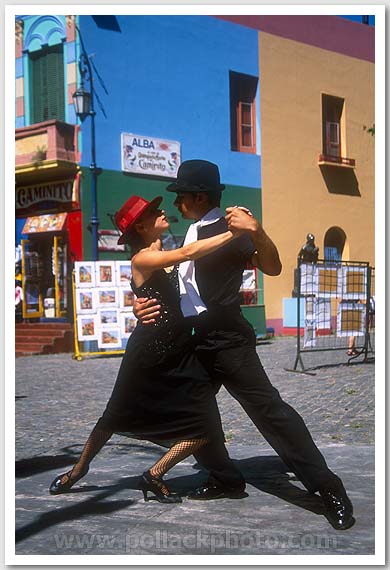
Over the past two days I have accomplished some great site-seeing. I visited Puerto Madero, La Recoleta, Palermo, El Retiro, La Plaza Mayor, San Telmo and finally made it to Boca. The picture above is from the sector of Boca (also the location of the best soccer team in all of Latin America!) I was really excited to make it to Boca this time around. Three years ago (holy cow I can not believe it has been that long), I avoided making the trip to the colorful corner of the city because Boca Jr. has just won the international cup in Japan against A.C. Milan. It was a little less crazy this visit.

Tonight I am catching a bus and will be on my way to Córdoba, Argentina! I'll be spending my Christmas with my Spanish camp coworkers as well as visiting my professors from my semester abroad in 2003. From there, I will head up to Santiago del Estero for Pablo and Laura's wedding!!!!

Okay, off to enjoy my last hours in the beautiful capital of Argentina: where all men have mullets, all the women are anorexic, and all the children are above average.

Tuesday, December 19, 2006


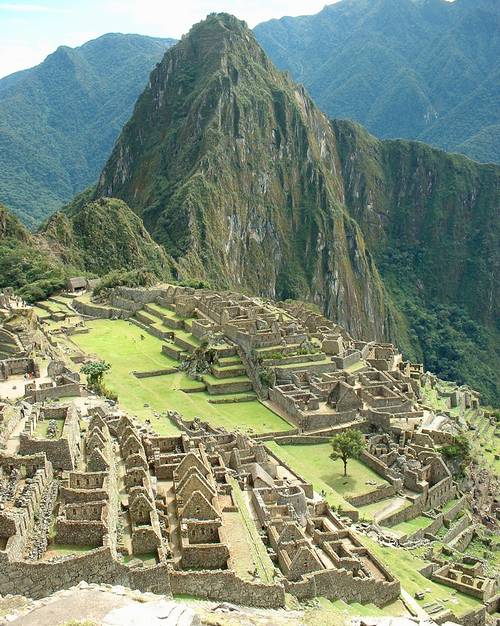
If you were to tell me 6 months ago that my dad and I would be climbing the peak of Waynapicchu (the mountain peak in the picture to the left), I think I would have laughed pretty hard.

Last Tuesday, I waited patiently outside the baggage claim door at the Cuzco Airport. A young, 22 year old, security guard decided to take the time to investigate my entire life story. I continuously looked over his shoulder, while politely responded to his interogation, as tourists exited the sliding doors. Finally, after a full 15 minutes, Security Officer, Alan Garcia (I thought he was joking that his name was the same as the nation's President until he showed me his ID badge) asked for my phone number. *Sigh*...another day of the overly flirtatious men of Cuzco. This time, though, I decided to take advantage of the situation. After passing my number, I asked Mr. Garcia if it would be possible to slip through the gate and wait for my parents in the baggage claim. I am sorry to report that the security conditions in the airport of Cuzco are not very tight.

I did not actually see my parents, as my mother practically tackled me on first sight. They were starting day 2 of 11 in a tour of Peru. With their 11 companions and tour guide, my parents and little brother, David, were treated to an amazing tour of Peru. Unlike most tours which take gringo foreigners to all the markets and ancient ruins, my family opted for an adventure packet that introduced them to the very complex and different realities of Peru. They visited children in a rural community school in the sacred valley, toured through homes and businesses of the poorest squatter town in Lima, and participated in a ritual payment to the earth with coca leaves by a local yatiri (a sort of witch doctor) in Cuzco. Their meals, housing, and events planned by the tour program were spectacular! While I only mooched off of one bus trip from Ollantaytambo to Cuzco, I was truly impressed by the organization and information provided by Raul, their guide.

I am very proud of them for making the trip. They definitely went out of their zone of comfort to try new foods, avoiding getting hit by crazy taxi drivers, and witnessing some harsh realities of third world society. All in all, I think I am allowed to say that they had a blast. We visited Machupicchu together and had time for shopping and a few meals between their programmed activities. My friends, Enrique and Gerson, also came from Puno to meet my parents and brother.

Certainly, I can not speak on their behalf for what they perceived on this trip, but I hope that you get a chance to chat with them and hear about my mom drinking coca tea, my dad accidently ordering five appetizers of calamari, my little brother buying riding combis with my friends and me, and all of us eating in the only gay restaurant in Cuzco.

Mom, Dad and David...thank you for the best Christmas gift ever: sharing a week in Peru with me. I love yous guys.

Saturday, December 09, 2006

The garden of the Altiplano or the forgotten side of Peru?

What a week.

A couple of weeks ago, my friend, Enrique, asked me if I felt it was hard to adapt to Puno. Rather confidently, I told him that I had learned how to adapt and accomodate to the realities that a new culture presented. This week was by far the biggest test of that assertion.

You know in movies when that new kid walks into the school lunchroom for the first time? It's as if time stops, the silence is deafening, and every single eye is penetrating the presence of the newbie. Okay, well that's how I felt almost every second of every day I was traveling in the province of Moho. Let's just say, it's not a touristy hot spot.

The region is located directly north of Lake Titicaca and borders the nation of Bolivia. In order to travel to Moho, one must take a combi from Puno to Juliaca (45minutes) followed by a bus to the provincial capital of Moho (2hours). I arrived with one of the members of the NGO, Jatha-Muhu, at about 8pm on Monday evening. The trip itself is not exhausting, but the roads are definitely not smooth. The regional government has not paved the highway and, because of the massive amounts of contraband trucks that pass each day, the roads are in wretched shape.

No cell phone signal enter the region and there was definitely no TV or internet. I went to bed around 7pm every day because after 3 or 4 hours of reading I was just tired from boredom. I slept in a relatively comfortable bed. Beyond that the housing conditions were...um...interesting. Let me just give you a hint of a sense of the bathroom: imagine a hole in the ground and two footprints in front to mark where to plant your feet. Okay, now crouch and go.

Day 1- The High Region.
In the morning we went to have breakfast in the center of the town. The house which the NGO rents does not have a kitchen and so food must be sought elsewhere. I was hoping for a piece of bread and a banana. They don't eat like that in Moho. Generally, in most parts of rural Puno, when the locals eat they don't skim on the servings. The population might be malnourished, but it's definitely not based on quantity. We walked into the restaurant and I totally lost my appetite. The sign on the door read "Caldo de Cabeza y Patas, Desayuno" direct translation: "Soup of Head and Feet, Breakfast". Crap. The imagine is really not lovely. Basically its a broth with the ENTIRE head of a sheep or baby calf. As I tried to work myself up to come face to face (literally) with my breakfast, the waitor walked up to our table with two plates of rice, french fries, and beef. PHEW. Turns out, you have to request the soup. Granted, I don't really see french fries, rice, and beef as the ideal breakfast, I gladly ate away.

My first trip took me to the provinces most remote (I didn't think I could get any more remote than I already was). I had to hire a car for the astronomical price of 90 soles for an hour drive up into the hills. Sincerely, the experience left me a bit down. The high region is very depressed and considered in extreme poverty. I met with the leadership for about an hour and they were very welcoming. While they want to participate in the project, they were also curious as to how much money I had and how my funding was used. Because I am doing academic research, I am ethically not allowed to give presents or donations to the community. It's really hard to maintain that attitude when you see the destitution in which the community lives. They told me of their frustrations with the district and regional government. "We are forgotten, " commented one of the leaders.


Day 2- The Middle Region
The second day travel took me to a community about a 45 minute walk from the capital of Moho. The leadership of the community are absolutely AWESOME! We had a good conversation and afterwards I asked them if they had any questions for me. They wanted to know how to develop a market for cuy, or hamster consumption in the US. I explained that it would be a bit difficult as, in my country, hamsters are seen as pets and it would not be likely that people would eat them. Once I gave them the comparison that it would be like eating cat or dog for them they started cracking up. They invited me to stay for lunch, and dinner, and....well...basically they did not want me to leave. I graciously accepted lunch, and promised to return in March. "Okay," one of the female leaders told me, "when you come back in March we will eat pet!"

I truly look forward to returning to this community. After spending five hours conversing with the community members (notably this is the first time I have been positively accpeted by the women), I really did not want to leave.

Day 3- The Lake Region
Okay, day 3 was the kicker. I had to travel alone because the NGO member had to return to Puno for a training program. The bus did not have any more seats, and so, stuffed like sardines for 30 minutes, I road to my final community visit. The president of the community was waiting for me when I arrived, and we walked 45 minutes from the highway to the main plaza.

There were 10 plastic chairs sitting in the middle of the plaza, and I was told to sit and wait as "we would be starting soon". After waiting for an hour under the direct sun (yes, my face is currently a nice shade of tomato) I sat next to the mayor and other leadership while the 20 representatives of the sector marched, played wood instruments, and raised the Peruvian flag. The community, bless their hearts, have to be the most patriotic bunch of peasants in the entire nation. Every Thursday (just my luck, the day I arrived) one of the 10 sectors of the community arrives to the population center's plaza to raise the flag and march in a parade. It was really a very pathetic event. Basically, the marchers marched for themselves...just crossing the plaza once with the flag. Don't worry, I videorecorded the whole bit.

Two hours later, we finally went inside the muncipality. I was watching my clock (12pm) as I needed to get to the highway to catch the 2pm bus back to Puno. I was promised that we would start the interview...just after having some fiambres or cold cuts. Okay, so first of all, the food is going to be a MAJOR issue for me. Each woman walked up to the center table and placed her portion of fiambres. In Puno, fiambres do not consist of cold meats and cheese. Dried beans, potatoes, and corn were pilled on the table. The meeting would not start until all the food was gone. Sigh. This was the second day I had to consume this food.

The frustrating part for me is that the community shows affection and hospitality by offering visitors more and more food. Rejecting the offer is like spitting in their faces. So, I tried to peel the beans as slowly as possible, but I could not avoid the lady that kept handing me more potatos and corn. Yes, I was very sick the following day and today I am still recovering a bit. Next time I return to the community, I will have stocks of cereal bars and fruit in my bag and will fib that I am sick in order to avoid a repeat of the past 24 hours.

After another excellent meeting, I was prepared to take off (though it was already 1:30). The president told me not to worry as a car from the community was driving to Juliaca and could give me a ride. Excellent! The president asked me to walk into a room with him, and I though it was just to chat. I was wrong. In walks a woman with a plate of trout and potatoes. Again, crap. The trout was complete with head, eyeballs, and scales. As I picked away at the skin, the other male leadership lunching with me ate everything but the skeleton. I admit, I had to avert my eyes as they chewed away at the trout's head.

Okay, it's 2:15pm and FINALLY I think I am ready to leave. The president informs me that the owner of the jeep and his companions have been drinking beer for the last 3 hours. Better to find an alternative means of travel. I hire a combi to drive me to the highway that connects with the next provincial capital of Huacané. Accompanied by the community mayor, president, and the driver's three boys, we make it to through the bumpy trek to the highway. There, the mayor assures me that there will be a combi passing by. Twenty minutes later, and five rejections of combis and even two contraband trucks, the leaders flag down a motorcycle. The biker agrees to take me as far as the bus stop to Puno in Huancané. That's right, folks, I am the new Che Guevara! I road on the back of the motorcycle for a half hour simply laughing to myself about how ridiculous my day had been. An hour combi ride to Juliaca followed by another hour combi ride to Puno, I finally arrived home sweet home.

I showered for the first time in five days and got to actually sit on a toilet. March is going to be REALLY interesting.

Friday, December 01, 2006

And so begins the process....

Below is a map of the department of Puno. Most tourists are only presented with the province of Puno. It is in this region where the city of Puno is located as well as the island communities of Amantani, Taquile and the floating islands of the Uros. Outside of this area, in the provinces of Moho, Huancane, Collao, Chucuito, and Yunguyo, the majority of the population is Aymara. In the rest of the provinces, the majority of are Quechua. So things are set! I officially have communities picked out for my research over the months of January and March. Today I met with the first group of leadership from the peasant communities within the province of Chucuito. The Institute on Rural Education has graciously given me the opportunity today to participate in a workshop for the authorities of the district of Kelluyo. I was able to present my project and get initial feedback from them regarding the conditions of health, education, and development. There have been a lot of frustration in the district because of the failure of the mayor to meet the needs of the community because of a major lack of transparency and accountability. Over the past 4 years the district has gone through 4 mayors! Luckily, the situation never became violent, but came close. There was a major sense of desperation in the leaders for access to information and knowledge about their rights in relationship to the elected power. Hopefully I will be able to help them understand what their rights and responsibilities are in relation to those of the local elected leadership.

So, during the month of January, I will live on the farm of the institute, also known as Fondo Palermo. It is located about a mile and a half away from the provincial capital of Juli in the province of Chucuito. They've got their own cows that produce all the cheese and milk needed for those who live on site. Lunch is served every day...and I will be assured a hearty helping of potatoes and soup every day.

The district of Kelluyo is farther away (about 2 hours) and I will travel there during the month with the help of the institute. As part of my research, I have promised anonymity to the participants and their communities. Therefore, I am unable to share with my blog readers the name of the communities where I will be working.

Next week, I am headed up to Moho, north of Lake Titicaca to meet leadership in 3 other communities. This region is a bit more isolated, but has a greater level of contraband shipment coming in from the Bolivian border.

Of the 6 communities I will visit, 3 are considered in conditions of extreme poverty whereas the others are considered impoverished. I still have to see what factors are presented for this level of poverty.

Thursday, November 30, 2006

Comunidades Campesinas...here I come!

And so begins the whirlwind of my travels through the rural peasant communities of Puno. I have just arrived in Juli, the capital of the province of Chucuito. Located an hour from the border of Bolivia, Chucuito is one of the larger Aymara provinces in the department of Puno. The town of Juli is known as the little Rome of Latin America because of its picturesque cathedrals.

I left Puno this morning at 6:45 am and arrived in Juli at 8am, a bit earlier than expected thanks to a very fast combi ride. This morning I will have meetings with the leader of a missionary group of the Catholic Church as well as the director of the Institute on Rural Education. The goal for the next two to three days is to visit some communities and meet with local authorities. After the New Year, I will live in the region for a longer period of time to complete my work with interviewing local and municipal leadership as well as holding community focus groups.

Surely, there will be fun stories to share over this week...

Saturday, November 25, 2006

a breath of fresh, contaminated air

"So is this what a bar in Puno is like?" The other Fulbright researchers from the provinces just laughed. Where or how to start to describe the differences? Alex, who probably dropped the fact that he went to Yale in every conversation he had during the week, was curious about what life was like outside the city of Lima. Most of the Fulbrighters agreed that he had not adapted very well to Peru living. The funny thing is that the idea of cultural adaptation is so relative. His complaints and frustrations of Lima seemed so trivial when I thought about the living conditions, politics, and conflicts I witnessed in Puno. Moreover, for all his negative commentary, he hardly had anything positive or good to say about his experience. I pittied him for not enjoying the past three months. Of course, we have all seen the good, the bad, the ugly, and the beautiful in our respective regions in Peru. I get the sense, though, that the students who stayed in Lima were not as fulfilled or happy as those who lived in smaller communities throughout the country.

It was quite amazing, actually, how very little the Limeñan Fulbrights knew about the lifestyle outside of the capital. Don't get me wrong, the city of Lima is a totally different world, in comparison to the United States. But, it's really a buffer in terms of cultural differences for a foreigner. As we sat in the bar named Sergeant Peppers (or Sargento Pimienta) in the upper class district of Barranco, I looked at the clientel that surrounded me. To be honest, I felt like I was one among a multitude of tourists. Unlike in Puno, I wasn't the only light-skinned, blue-eyed youth in the room. We were definitely in a pituco bar. The term refers to the rich population of the capital city. Often, people from the provinces refer to the Limeñans, in general, as pitucos, though it primarily defines the population that live in the city's districts of Miraflores, La Molina, Sucro, Barranco, and a few others. For the first time in three months I felt underdressed....no, under-fashionable in a bar scene.

The week has been a refreshing break from Puno. On Monday and Tuesday, I had meetings with the top advisor of the National Council on Decentralization and worked at the library in the Catholic University of Peru. Wednesday was spent in a researcher's workshop to present our projects and get feedback from Peruvian scholars. Friday, I traveled to the US Embassy to have pages added to my passport (yup, I have travelled that much) and had a turkey feast with Embassy staff and Fulbrights. In between, I did some shopping, walked around the city, and got a much needed hair cut. All in all, a worthwhile trip.

It has definitely helped to gain a bit of perspective from the other Fulbrighters as well as share knowledge about Puno to people who are unfamiliar with its culture (I even taught people from Lima things about Puno they didn't know!) Additionally, I was able to enjoy some comforts that made me feel a bit closer to the States: hot showers, comfortable sofa-chairs in coffee shops, movie theaters, big-red gum, walking around shopping malls, political conversations over dinner with other researchers, big red gum, libraries, cable tv in my room, NFL sportsbar to watch Thanskgiving games, soy milk, mexican and sushi restaurants...

Still, Lima is neither where I belong nor what I love about Peru. I know from that list I make Puno sound like it is in the middle of nowhere. These are just little things that are not in my life in the highlands. On the flipside, there are things about Puno that I miss and really look forward to having once I return on Sunday: clean air, a sense of security on the streets and taxis, greeting people I know as I walk around town, great meals for 5 soles (average price for a meal in Lima's tourist district is 20-30 soles), my friends, not feeling under-dressed all the time, daily parades...

I just stopped a moment and took in what I wrote in the two paragraphs above. Almost all the little bonuses of Lima were materialistic in nature, whereas my pluses of Puno were more subjective and in reference to a sense of community. Maybe that's what I forgot to share with Alex from Yale :

The difference between a bar in Lima and a bar in Puno isn't based on the kind of drinks you have, the music they play, or the clothes people wear. The real difference is that, unlike in sprawling city of Lima (population 9 million) you have had the opportunity to insert yourself in the a community of a bar's clientel...where everybody knows your name (is the theme song ringing in anybody's head?)

I think the other province Fulbrights would agree.

Monday, November 20, 2006

Lima...take two and tasting much better

I am back in Lima! This time, I am here for a week event hosted by the Fulbright Commission. I will have to admit, I was not looking forward to coming to the coast. Last time I was here, I definitely had a foul taste in my mouth for the city. The past 24 hours, though, have been marvelous! The Fulbright has put me up in an extremely comfortable hostal in the calm district of Barranco. Having a nice room with an exceptionally chill atmosphere definitely makes a big difference.

Since I have arrived to sea-level (after 3 months up at 13,000ft) I feel like I could run a marathon. Its seriously an amazing feeling to take huge, deep breathes...and enjoy the smell of the ocean at the same time. Oh, that's the other thing! My current spot is right next to the coast and I have already enjoyed two long walks to Miraflores, looking off into the Pacific. Seeing the sun, and enjoying 70 degree weather makes quite a difference. My only complaint was that once I got to Miraflores, the Starbucks was having problems with their water filtration and I couldn't buy a drink. I know, I know...but come on! You think I can go for an entire year without a tall americano!??!!?

This morning I met with the top advisor of the National Council on Decentralization. Because the local elections just finished yesterday, he was a tad preoccupied and apologized for having to cancel our meeting. Granted, he still met with me for an hour and invited me to return later this week for a more formal interview. He's so great...definitely an old, liberal sociology professor stuck in the body of a political advisor.

I think the main activity this week will be hanging out in the Catholic University library. Of course, I will take a quick break on Friday to have turkey and gravy with the other Fulbrights and (I think) the US Ambassador.

OH, and I have to share the exciting news!!!!! I just found out from another Fulbrighter that we are being flown to Cartagena, Colombia in April for a conference with the Andean nation Fulbrights! How cool is that?!!?!?

Thursday, November 02, 2006

In the land of swimming cows

I must apologize for having taken a bit of a break from sharing my stories on my blog. Things have been a bit crazy as my semester comes to an end. I have finished my internship with IDEA and sent in my thesis proposal for my professor at American University. I am headed off to La Paz on Thursday for a day trip and then I will be in Lima for the entire following week...having the Turkey Dinner with my fellow Fulbrights and the Ambassador of the US.

After next week, I will begin my interviews and field research at full force! I will be doing a LOT of traveling through the month of January, so please be patient with my entries. They will be spontaneous, but very interesting!

Of course, I need to share with you my weekend visit to the island of Anapia. This took place a few weeks ago, and I have taken forever to finish the entry....but here goes:

Last Thursday I traveled to the border of Peru and Bolivia to spend the weekend on the island of Anapia. Having worked on the child literacy program in conjunction with the director of a local island NGO, I took up his invitation to visit his home.

After a trip that included 2 hours, in a bumpy combi , 3 hours waiting in the market of the town of Yunguyo (and getting pretty unfriendly stares from the women of the city), another half hour bumpy ride and a sloooooow 2 hour boat trip on the village communal boat (with a bag of something that smelled REALLY nasty right in front of me), I arrived to Anapia. To my surprise, my contact, Jose was not waiting for me on the dock. A young girl from the community took me to his house, but it was empty. Turns out, he was still in his chacra (farming field) planting potatoes. The town was empty as everyone was working on the fields. As the sun was setting, I wasn't sure what to do or where to go.

Luckily, the children in the community were very friendly, and one invited me to wait in his home until Jose returned. As it turned out, I was suppose to be greeted by my weekend hostess, Maritza...she had just turned up a bit too late to the dock. Her home was GORGEOUS! The guest room was even more comfortable than my home in Puno. To my suprise, unlike the island of Amantani, there was electricity, running water, toilets, and even a hot shower!

I was truly blown away by the organization, cleanliness, and calm of the community. They have not been overwhelmed by the tourism experience, but instead have prepared and adapted to the presence of small groups of visitors. I was invited to create my own schedule for the weekend...basically I could do whatever I wanted!

So....on Friday, I went with my host, Hidilago, to attend his third grade class at the local school. We had discussed over dinner the previous night the work I had done in Amantani as well as at Concordia. To my surprise, I was invited to teach the class! It was really fun! We did math, reading, and spelling activities. The kids taught me some songs and I shared games and songs from camp with them. They were full of very intruiging questions like, "Why do you write with your left hand?" and "Why does the snow fall in Minnesota?" If anyone has those answers...please let me know because I did my darnest trying to figure out how to explain them!!!!!!!!!!!!

On Saturday, Maritza and I walked to the other side of the island, jumped in one of her friend's row boats, and went to the neighboring island, Yuspiqui. While the community lives in Anapia, they maintain their farming fields in Yuspiqui. I had arrived just in time for the potato planting season. We arrived at Jose's chacra where his wife, son, and daughter were working the land. Maritza and I joined them, breaking the soil and prepping the seeds.

Anapians don't use any chemicals to prep their seeds. They go the natural route....using NATURAL fertilzer. In a bucket, Jose's wife had a lovely mix of vicuña (a wild cousin of the llama) poo and pee. They cover the potatoes with the vicuña salsa (hahaha) and let it sit out in the sun.

After prepping the potatos we had lunch (I swear I doused my hands in that sanitizer lotion). Lunch was a blanket full of boiled potatoes, chuño, and fried eggs. Maritza, worried about my Westerness, had brought everything except the kitchen sink....silverware, plates, the salt shaker, and even the tea cups and saucers. In the end, though, we ate just like Jose's family...picking at the potatoes with our hands. Lunch was finished off with a cup of tea and chewing some coca leaves. Jose taught me how to bless the potatoes "so that they will grow bigger than my head" and thank the Pachamama (Mother Earth) for her help in their fields.

With the help of two oxen, we finished planting the potatoes in the fields. I was in charge of dropping the potato seeds into the open earth. They instructed me to place each potato a foot-length apart. In reality, I had to place them about a half a foot-length apart...my feet are a bit longer than that of the women in the island.


Once we had finished dropping the poo covered potatoes into the ground, Maritza and I took off in search of a ride home to Anapia. We finally found one boat that was about to depart. They asked us to meet them about a half mile down the island where their cows were waiting for them. Cows waiting? Alright....I hope you are ready for this:

One of the boat's passangers helped us onto the boat and then began pushing the cows towards the water. That's right, cow's swim. The two hephers were great swimmers, nor did they seem too happy. Their bellies floated about the rest of their bulk and their eyes scanned wildly. I felt really bad for them, and to be honest was a bit worried they would tip the boat! Still, they made the 20 minute swim to Anapia. So now I think I know the true way to make ice cream (yuck, yuck!)

Sunday, October 15, 2006

The Rural Traveler

I just got back from another weekend on the island of Amantani. The community of Suncayani Alto welcomed me with open arms... 80 little arms to be exact. We are trying to develop this project with an emphasis on having Puno's local university students take the iniative in volunteering. Unfortunately, folks were a tad too busy this weekend partying. I must admit, I was a tad upset that no one would take the time to travel for a day to the island. One of my to-be companions showed up at the house around 1pm...a bit late seeing as the boat leaves at 8am on the dot. So I was alone to receive the hugs from the island's children.

After settling in Silverio's house and having lunch with two very shy Swiss tourists, I was off to the community's school. I hoped to meet roughly 20 kids, as that had been a relatively manageable number last weekend. Not surprisingly, word had spread about the activities and books that I had brought last Saturday. I was confronted with 40 VERY animated kiddies. We played a couple of games that drew lots of giggles. Afterwards (and I am still amazed about this), I read an entire book to the kids and actually kept their attention! Even better...the kids understood the story after I asked them some comprehension questions.

After finishing the story of Pinochio, I asked them what special tool the fairy used to turn Pinochio into a real boy. "A magic wand!" the kids exclaimed. "Very good!" I told them "Now, I don't have any magic wands, but today I have a very special magic box for you all." In my special box were 50 pieces of colored chalk. Each child got to pick the color of the chalk and draw the different characters from the story. They wrote the names of the characters and drew Geppeto, the fairy, the fox, the cat. One boy even copied the image of Geppeto and Pinochio in the boat fleeing the angry whale. This wasn't enough for the kids, and they wanted to draw more characters....Little Red Riding Hood and the wolf, Alice in Wonderland and the rabbit. Within an hour the entire patio was filled with blue, yellow, red, and brown images and words. Let me tell you...there were a LOT of mean-looking whales on the school patio yesterday!!! Project chalk....accomplished and quite fun.

The rumor had spread on the island that I was going to shower the children with books, notebooks, pens, etc. The goal of our work is not to dump gifts on the population. Instead, we are trying to work with them to promote a reading culture. When I met with the parents, the proyect was clarified in this sense. They had just finished building a kindergarden for the younger students. We discussed the option of using a small portion of the center for a library. I promised to make a deal with the community. As our intent was not to simply donate things in the community and run, our group would work with the community to create the library. If the community agreed to develop a communal fund for purchasing books, materials, as well as maintaining the local, the volunteers would help with the construction and purchasing of materials to begin the library.

To anyone reading this in the U.S., if you are interested in donating to our project please let me or my mom know! The easiest way would be to send money to buy products (chalk, notebooks, books). My hope is to also gather funds to purchase a stereo and buy basic English/French/German comprehension tapes so that the families can develop basic vocabulary in order to communicate with the tourists they house.

The parents were very upbeat, and decided that they would vote on the issue in the upcoming weekly meeting. They asked me how much money the project would demand of them. I told them that a) it was not my place to make that decision, but it would be an important issue to debate in the community, and b) I recommended that they designate a small monthly fund in order to consider this project as a long-term, sustainable resource for all to enjoy. Again, the important knowledge that we as volunteers will offer is how to create a space that is respected and enjoyed by everyone in the community.

The kids and parents were a bit upset that I won't be back on the island for three weeks. While I do enjoy spending a day in Amantani, I really think it is necessary that others in our group step up and get involved. Additionally, I have made some other committments for the next two weekends to share with you all later....but here is a quick preview:

next Saturday- writing party with the kids on the floating island of Kuntiki...the kids are going to make up myths about their island. Either I will go to their island or they will come to Puno and we will go do some shopping at a book store!

following Saturday- I will be donating my fertile youth to the fields of the island of Anapia. I will be working with one of our island coordinators, Jose Flores, on his land and getting to know his community.

I left the Amantani this morning at 5am on the communal boat and arrived in Puno to shower and repack my bags. This afternoon I am heading out to the rural province of Chucuito to begin my contacts, interviews, and setting dates for my focus groups following the new year. This week, I will be staying in the city of Juli with two German theologians and working with the contacts I have made through my host institute as well as the Institute on Rural Education. I will return to the city of Puno on Friday with lots of stories and hopefully lots of interviews/meeting dates. Keep your fingers crossed!